
The reading is sitting on her screen: 0.041%, timestamped fourteen minutes ago, with an operator's name and employee number beside it. The man is standing on the other side of the desk in his safety shoes, insisting he has not touched anything since Sunday. The supervisor who ran the test has already gone back to the floor.
Whatever happens next carries her signature. And the question in front of her is not really a question about the BAC tester. It is a question about what a single screening number entitles an employer to conclude.
Get that wrong in either direction and you either put an impaired operator on a press, or you stand a sober worker down on a reading that will not survive a grievance hearing. This article is about that gap: the distance between a number on a screen and a defensible action.
What is a BAC tester, exactly?
A BAC tester is a breath instrument that samples deep lung air and estimates blood alcohol concentration from it. In workplace use it is a screening tool: it sorts people into "proceed" and "do not proceed until this is resolved". It is not a diagnostic instrument and it is not a laboratory.
The estimate exists because blood is what impairment research is calibrated against, while breath is what you can actually sample in seconds at the point of work, without a nurse, a needle or consent paperwork for every test.
The reading is an estimate, and it is designed to be
A BAC tester measures alcohol in exhaled breath, then converts that figure to an estimated blood alcohol concentration using a fixed physiological ratio.
That ratio is an assumption applied to every person who blows into the device. Breathing pattern, body temperature, how deep the sample was, and how recently the person put anything in their mouth all move the number. A good instrument narrows the spread. Nothing removes it.
So a screening result answers one question well: is there a reason to stop this person from starting work right now? It does not, by itself, answer how much did this person drink, when, or are they impaired. Those are conclusions you build, not conclusions the device hands you.
What BAC means in alcohol testing, in Indian terms
BAC is the mass of alcohol per unit volume of blood, written either as a percentage or in milligrams per 100 ml. Two reference points matter for an Indian workplace.
The road limit. Under Section 185 of the Motor Vehicles Act, 1988, the threshold is alcohol exceeding 30 mg per 100 ml of blood, detected in a test by a breath analyser. That is 0.03%. Anyone driving a company vehicle on a public road is measured against that figure, whatever your internal rules say.
Your policy limit. For work inside the fence, in a crane cabin, a confined space, a shop floor or a control room, there is no single statutory breath figure that applies to everyone. The limit is whatever your certified standing orders, service rules or contract say it is. Most industrial policies set zero tolerance, because a fitness-for-duty standard is far easier to enforce than an argument about degrees of impairment.
The practical consequence: you must know, before the test, which number triggers which action. Deciding after the result appears is how policies get overturned.
Most handheld units display in mg/L of breath rather than %BAC. Roughly, 0.03% BAC corresponds to about 0.14 mg/L of breath, though devices differ in how they display and round. Fix one unit across the whole site and train everyone in it. Mixed units on the same register are a documentation problem waiting to happen.
What you may conclude from one screening result
You may conclude:
- The device detected alcohol in the breath sample above the threshold you set.
- Your policy's stated consequence for that band is now triggered.
- The person should not begin safety-critical work until the result is resolved.
You may not conclude:
- That the person drank at work.
- How much they consumed, or when.
- That they are impaired in any clinically defined sense.
- That the number is exact to the last digit.
That last point is the one that catches HR teams. A reading of 0.041% is not a measurement of exactly 0.041%. It is a measurement that sits somewhere in a band around 0.041%. When a reading is far above your limit, the band is irrelevant. When it sits a whisker above, it matters a great deal, and that is precisely when people contest it.
Why the second test is the one that counts
A screening result becomes usable when it survives a confirmation step. Build these into the written procedure, not into the supervisor's judgement.
Wait and retest. Alcohol left in the mouth from a recent drink, mouthwash, cough syrup, a mouth spray or a burp can sit on the sensor and produce a reading that has nothing to do with the bloodstream. A wait of 15 to 20 minutes with nothing consumed, followed by a fresh test, clears mouth alcohol. If the second reading drops sharply, the first was contamination. If it holds, it is systemic.
Repeat on the same device, then consider a second device. Two consistent results from a properly calibrated fuel cell instrument are hard to argue with. Two results that disagree wildly point at the instrument, the mouthpiece or the blow technique, not at the person.
Escalate to a confirmatory test where the consequence is serious. If the outcome is dismissal, a disciplinary charge or a police referral, a screening reading should not be the only evidence on file. Send the person for a medical examination or a blood test at a recognised facility, with the referral and consent documented. Screening tells you to stop the shift. Confirmation tells you what can go into a charge sheet.
Record refusal separately. A person who declines to provide a sample has not tested positive. Your policy should treat refusal as its own defined category of misconduct, with its own consequence, so that nobody ever has to argue that a refusal means a positive.
Which BAC tester is the most accurate?
The honest answer: the sensor type sets the ceiling, and calibration decides whether you ever reach it.
Semiconductor sensor Fuel cell sensor
Typical use Personal, low-volume checks Workplace, fleet, security screening
Selectivity for alcohol Responds to other substances too Reacts specifically to ethanol
Drift over use Faster Slower and more predictable
Suitability as decision evidence Weak Appropriate, with calibration records
Semiconductor sensors can respond to compounds other than ethanol, including substances a diabetic worker or someone on a low-carbohydrate diet may exhale. For a family car or a personal check before driving, that is tolerable. For a reading that decides whether a man loses a day's wages, it is not.
Marketing claims of "police grade" mean nothing without a calibration certificate behind them. What you are buying for a screening programme is repeatability and a service trail, not a headline accuracy figure.
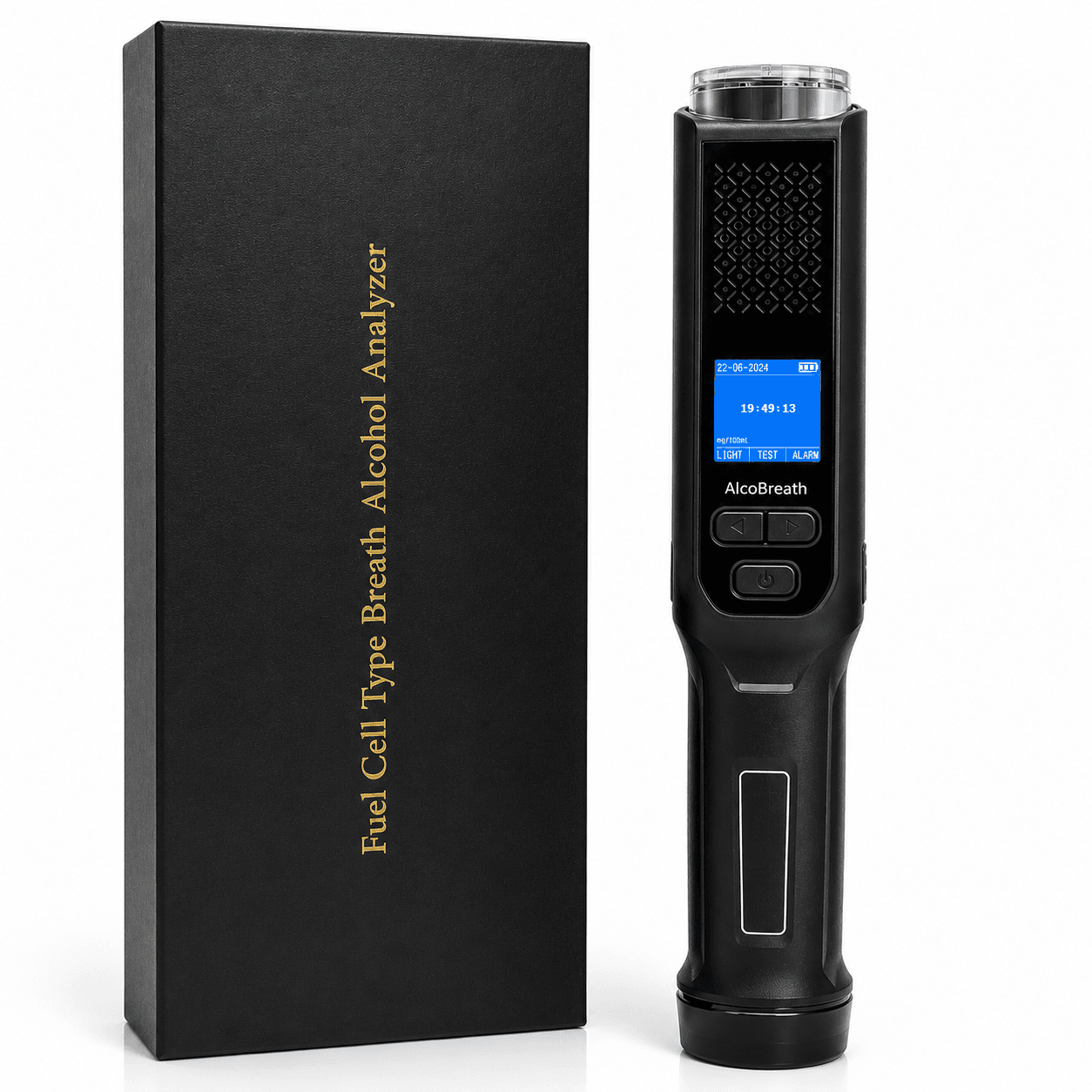
For any programme where results are recorded and acted on, use a fuel-cell breath analyser built for repeated high-volume screening, with a documented calibration cycle. AlcoBreath's professional range is specified for exactly that pattern: high daily test counts, replaceable mouthpieces, and a service schedule you can produce on request.
Calibration is what makes a reading defensible
Every breath alcohol sensor drifts. A device that reads accurately on the day it arrives is not automatically accurate eleven months later.
What an audit or a hearing will ask for:
- The date of the last calibration, and by whom
- The certificate for that calibration
- The number of tests performed since
- Whether the operator was trained, and when
- The log entry for the individual result being disputed
If you cannot produce those five things, the number on the screen is an opinion. Set a calendar-based calibration cycle and a usage-based one, and follow whichever falls first. Keep spare mouthpieces stocked so nobody is tempted to reuse one, which is both a hygiene failure and a contamination source.
Turning readings into a written response
Bands, not judgement calls. Publish the table, brief the supervisors, and hold to it.
Screening result What it may indicate Standard response
Zero / below threshold No detectable alcohol Cleared for duty; log the test
Just above threshold Possible mouth alcohol, residual alcohol, or genuine low BAC Remove from safety-critical work, wait 15–20 minutes, retest
Confirmed above threshold on retest Alcohol present in the system Stand down for the shift, arrange safe transport home, start the policy process
High reading with visible impairment Significant intoxication, possible medical risk Do not send home unaccompanied; medical attention first, then process
Refusal to test Not a positive Handle under the refusal clause of your policy
Two details protect the employer. First, never let a person you have stood down drive themselves home. If your reading is correct, you have knowingly released an impaired driver onto a public road. Second, conduct the test in private, away from the rest of the workforce. A screened area or a small room costs nothing and removes the humiliation argument from every hearing that follows.
How can I test my own BAC?
Workers and family drivers ask this constantly, usually the day after. A personal breath tester will give a useful indication, provided you wait at least 15 to 20 minutes after the last drink and blow steadily for the full duration the device asks for.
Set the expectation honestly, though. A personal reading of zero is not a defence and it is not a substitute for the site test. Alcohol clears at its own pace, and no amount of coffee, food, sleep or a cold shower speeds it up. The real value of a personal tester is that it teaches an individual how long their own body actually takes, which changes behaviour on a Tuesday night far more effectively than a poster on a notice board.
The same logic applies to families with one shared car. A device kept in the glovebox is not there to permit borderline driving. It is there to settle the argument before someone starts the engine.
What accountability looks like here
If screening is skipped and something happens on your premises, the questions arrive in a fixed order: was there a policy, was it applied consistently, was the device fit for use, and who signed off. Those questions land on the safety lead and the HR head, not on the supervisor who happened to be holding the unit.
A workable programme is unglamorous. A written policy with defined limits and defined consequences. A fuel-cell device with current calibration. Trained operators. A confirmation step before any serious action. A log that someone actually reads.
Once those five exist, the moment described at the start of this article stops being a dilemma. The HR lead is no longer deciding what a number means. She is following a procedure that was decided long before the worker walked into her office, which is the only version of this that holds up.
 9,500
9,500