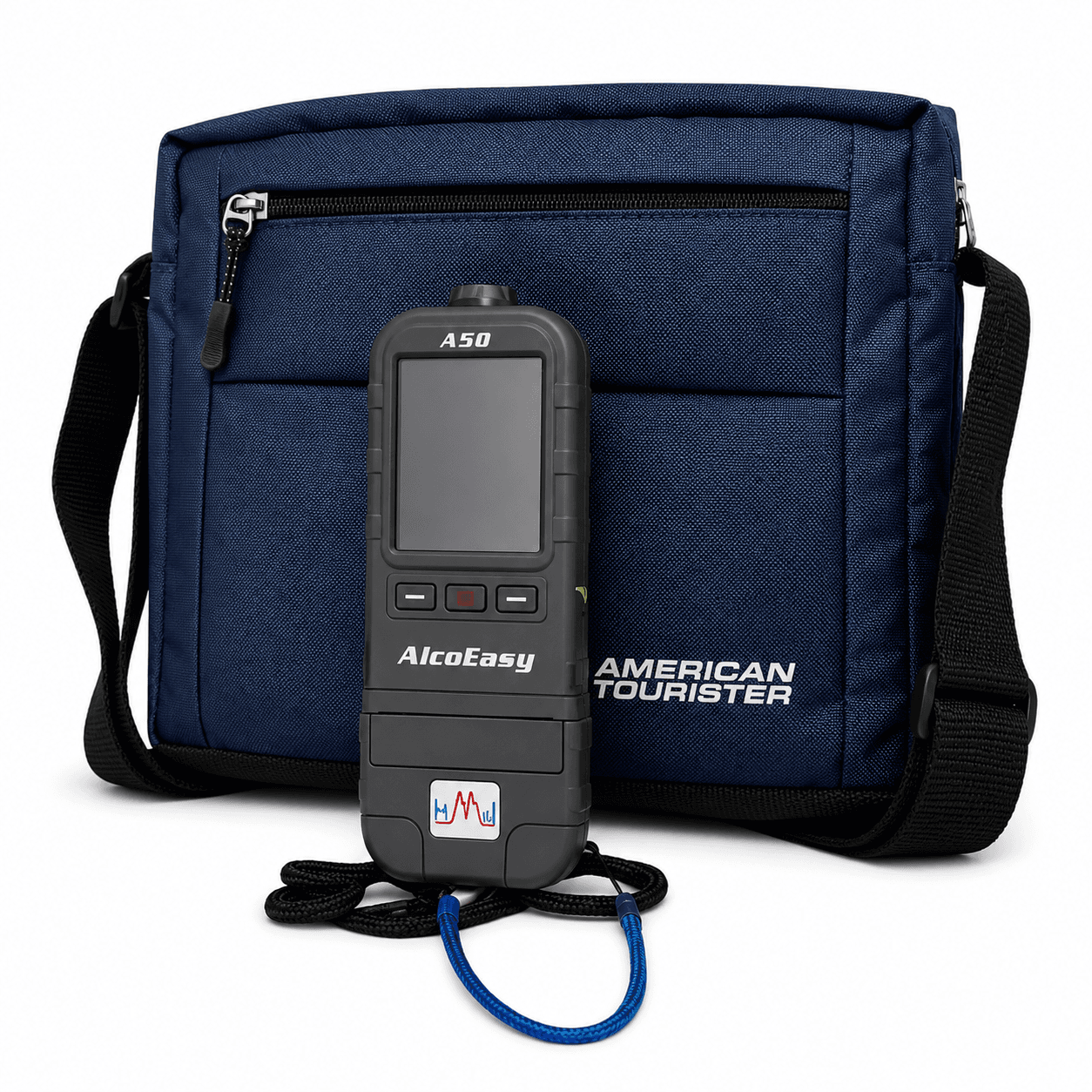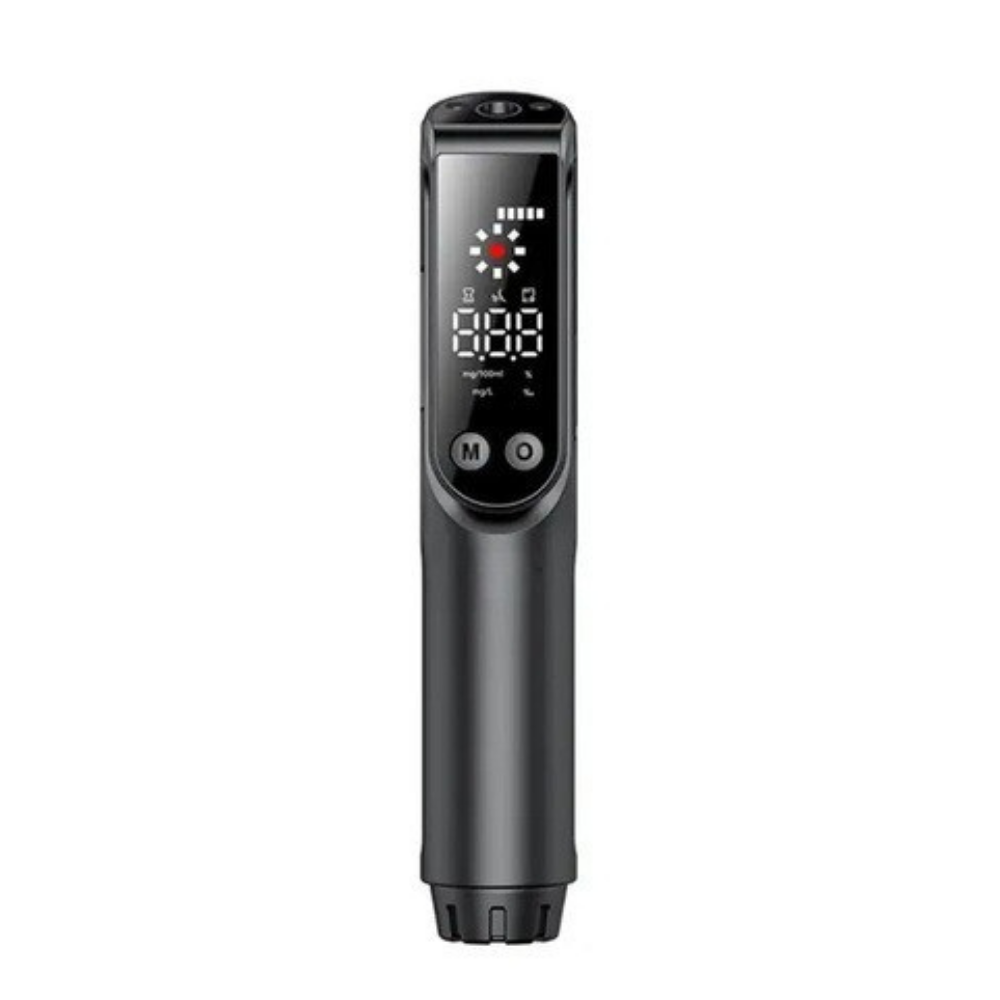

A driver at a Pune logistics depot blows into the handheld at 2:40 in the afternoon. The screen shows a number. He says he had one drink the previous night, that he feels perfectly fine, and that the machine must be wrong. The supervisor now has to decide whether that truck leaves the yard.
That decision is the real subject of a breath test for alcohol limit. The device does not decide anything. It produces a value, and the person holding it has to know what the value means, what the legal line is, and what the company's own line is, because those are three different things.
The short answer: where the line sits in India
Under Section 185 of the Motor Vehicles Act, the offence is driving with more than 30 mg of alcohol per 100 ml of blood. In percentage terms that is a BAC of 0.03%. On a breath instrument reading in mg per litre of breath, it works out to roughly 0.15 mg/L.
India's limit is stricter than the 0.08% figure that dominates search results, because most of those pages are written for the United States. If you are running vehicles or a worksite in India, ignore 0.08% entirely. Your reference point is 0.03%, and the penalty regime for crossing it includes fines and the possibility of imprisonment, tightened by the 2019 amendments to the Act.
For the full legal picture, including repeat offences and what happens to the driver and the vehicle owner, read our detailed piece on drink and drive in India: the law, the limit and who carries the risk.
Reading the units without guessing
Most disputes over a breath test for alcohol limit start with confusion between units. Different devices, and different documents, express the same quantity in four ways.
How it is written Value at India's legal limit What it describes
BAC percentage 0.03% Alcohol in blood, as a percentage by volume
mg per 100 ml of blood 30 mg/100 ml The wording used in the Motor Vehicles Act
mg per litre of breath about 0.15 mg/L What most professional handhelds display
µg per 100 ml of breath about 15 µg/100 ml The same value on a finer scale
So a device showing 0.05 mg/L is well under the limit. A device showing 0.05% BAC is well over it. Same digits, opposite conclusions. Before you buy anything, fix the display unit your policy will use, put it in writing, and train supervisors on that one unit only.
How the test estimates a blood figure from breath
Alcohol is not digested in the mouth or the lungs. It passes into the bloodstream and, as blood circulates through the lungs, a proportion of it evaporates into the air in the deep alveolar sacs. A breath tester samples that deep lung air and converts it to an equivalent blood concentration using a fixed ratio.
That is why the last part of the exhalation matters. A short puff, a covered mouthpiece or a person exhaling through the nose gives a low, useless reading. A proper test needs a steady blow of four to six seconds until the device signals that it has captured the sample.
Sensor type decides how much you can trust the number:
- Fuel cell sensors react electrochemically with ethanol specifically. They hold their calibration longer, resist interference from other substances, and are the right choice wherever a reading may be challenged or recorded.
- Semiconductor sensors are cheaper and quicker to warm up, but they can respond to other vapours and drift faster. They belong to personal and awareness use, not to disciplinary decisions.
Our breathalyzer test guide covers the sensor comparison and accuracy factors in more depth, and the alcohol testing machine guide walks through the buying decision by use case.
The 15-minute rule that saves you an argument
Mouth alcohol is the single most common cause of a false high reading. Residue from a recent drink, mouthwash, a breath spray, gutkha-style flavoured products, or vomiting sits in the mouth and inflates the result far above the true blood level.
The fix is procedural, not technical. Wait 15 to 20 minutes after any of these before testing, with nothing consumed in between. If a reading looks improbable, wait the interval and retest rather than escalating on the first number.
Other things worth building into the procedure:
- Fit a fresh mouthpiece for every person, and record how many are in stock so testing never stops for want of consumables.
- Do not test immediately after heavy physical exertion; let breathing settle.
- Keep the device out of direct heat, paint fumes and solvent vapour.
- Send the unit for calibration on the manufacturer's schedule. An uncalibrated device that has sat in a drawer for a year is not evidence of anything.
Legal limit versus workplace limit
Here is where many organisations get stuck. The 0.03% figure is a road traffic threshold for prosecution. It is not a safety standard for operating a forklift, working at height, entering a confined space or handling a lathe.
Most Indian factories, mines, warehouses and fleet operators that screen seriously set a zero-tolerance threshold: any detectable reading above the device's lowest reportable value means the person does not start the task. That is a policy choice, and it is defensible precisely because impairment of reaction time and judgement begins below the legal driving limit.
What a workable policy states, in plain language:
- Who is tested: all safety-critical roles, plus post-incident and reasonable-suspicion testing.
- When: at reporting time, on return from break where relevant, and after any incident.
- The threshold, in one unit, and what happens above it.
- Who conducts the test and who witnesses it.
- The retest right and the confirmation step.
- Where the record is kept and for how long.
If you are still building the internal case for screening, why companies need alcohol testers sets out the argument in terms a management committee will recognise.
When the reading is disputed
Back to the depot. The driver says the machine is wrong. A policy that anticipated this moment gives the supervisor four steps instead of an argument.
- Wait and retest. Fifteen minutes, same device, witness present. Mouth alcohol falls away; genuine blood alcohol does not.
- Confirm on a second unit if the retest is still positive and the consequence is serious.
- Log everything: time, device serial, last calibration date, both readings, names of tester and witness.
- Separate the safety decision from the disciplinary one. The person is stood down from the task immediately. The consequence is decided later, through the process, on the record.
Screening devices are screening devices. Where a matter goes to the police or to court, evidential instruments and blood tests take over. Your job is to keep an unfit person away from a vehicle or a machine, and to be able to show why.
How long alcohol stays detectable
The body clears alcohol at a fairly steady rate, and nothing speeds it up. Coffee, a cold shower, food, exercise and sleep change how a person feels, not what the sensor reads.
As a practical rule, a heavy evening of drinking can still register on a morning shift test. Late-night drinking followed by an early report time is the classic pattern behind positive readings in people who insist they are sober. Tell your workforce this before you start testing, not after the first person is stood down.
Choosing a device for limit-based screening
Match the device to the consequence attached to the reading.
Use What to look for
Gate or depot screening of many people Fuel cell sensor, fast recovery between tests, high mouthpiece throughput
Post-incident and supervisory checks Fuel cell, printed or downloadable records, clear calibration history
Site and event entry Passive or contact-free mode for speed, followed by a confirmatory blow test
Household and personal awareness Compact unit, understood as indicative only
For family and personal use, our note on the home breath alcohol analyzer explains what such a device can and cannot tell you. For organisational buying, the comprehensive guide to alcohol testing machines and the overview of features and uses cover specifications, and buyers in one of India's busiest fleet markets may find the alcohol tester in Mumbai buyer's guide closer to their situation.
If you are equipping supervisors who will make stand-down decisions, ask AlcoBreath for a fuel-cell professional model with a documented calibration schedule rather than the cheapest unit that fits the budget line.
Who carries the consequence
Not the device, and rarely the person who blew the number. When an unfit driver leaves a yard, the consequence lands on the transport manager who signed the trip sheet, the safety head whose policy existed only on paper, the owner named in the FIR, and the family in the other vehicle.
A breath test for alcohol limit takes under a minute. Knowing what the number means, in which unit, against which threshold, is what turns that minute into a decision you can defend.
 16,000